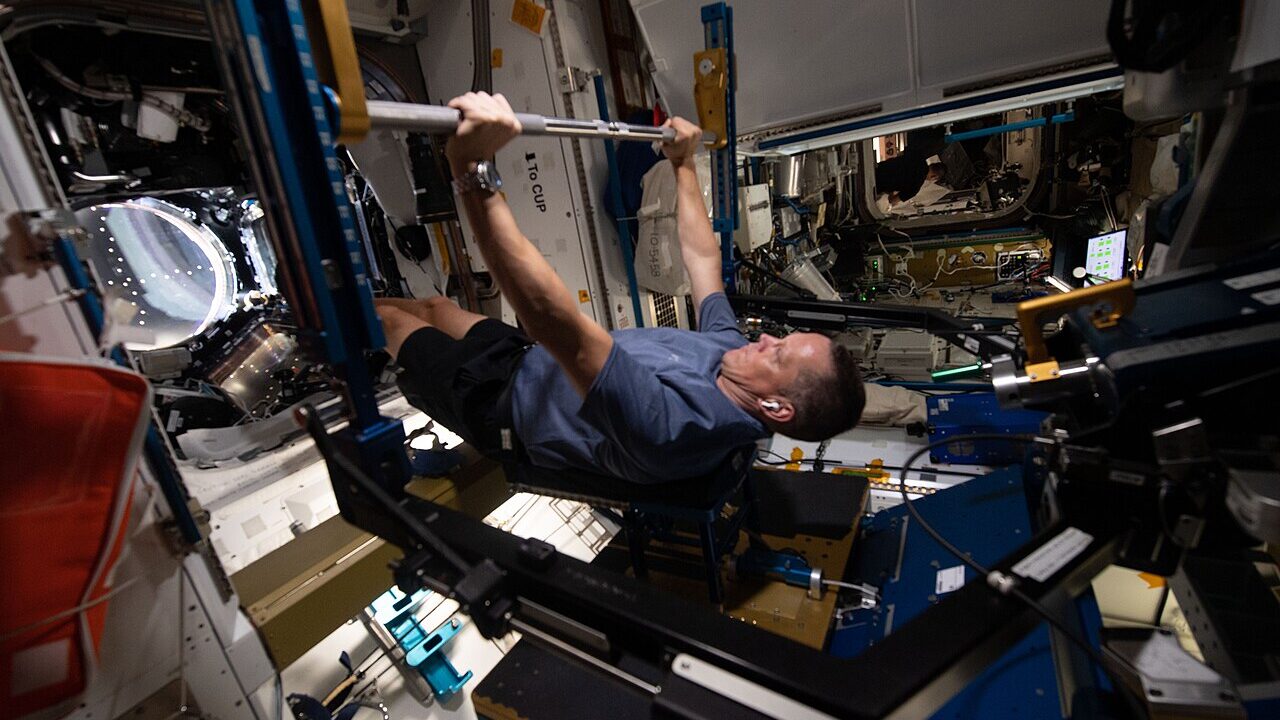
Exercise in space appears to protect astronauts’ cardiovascular systems well enough that, after six months in orbit, their hearts handled the gravity of Mars — simulated as three-eighths of Earth’s — no worse than they handled standing upright on Earth before flight, according to research described by the study’s lead investigator and published in the journal Circulation. The finding addresses one of the quieter showstopper questions hanging over a crewed Mars mission: whether astronauts would arrive able to work.
The mission profile is unforgiving. A Mars voyage means roughly six months of weightlessness outbound, eighteen months on the surface, and six months back. Weightlessness is known to weaken bone and muscle and to remodel the cardiovascular system, which no longer has to fight gravity to move blood. The fear was that crews would step onto Mars deconditioned at precisely the moment the mission became most demanding — and most dangerous, since a cardiovascular emergency is, by the researchers’ analysis, the most likely catastrophic medical event in a middle-aged crew.
The new work went beyond the usual proxies. Rather than inferring heart function from blood pressure and pulse, the team taught astronauts to perform echocardiograms — ultrasound imaging of the heart — on themselves in flight, producing direct pictures of how the heart changes across a mission and how exercise countermeasures affect it. None of the astronauts studied showed a cardiovascular response to simulated Mars gravity that was more stressed than their pre-flight response to standing on Earth.
The caveats are the usual ones, and they matter: the sample is the astronaut corps, which is small and exceptionally fit, and Mars itself will add radiation, dust and distance that no Earth study can simulate. But the specific fear the study addressed — that the heart would be the weak link on arrival — came back reassuring.
For mission planners, that converts one red item on the risk chart to amber. The treadmill, it turns out, may be as mission-critical as the rocket.
The research also quietly rearranges the countermeasure hierarchy. Exercise has been the station’s workhorse prescription for thirty years, consuming crew hours that mission designers perpetually try to reclaim for science. Evidence that it measurably preserves the heart’s gravity-readiness strengthens its claim on those hours in exactly the arena where the argument matters — deep-space vehicles so small that every device must justify its volume. A smaller, smarter descendant of the station treadmill is now easier to defend in design reviews. The study’s authors are careful, as their field requires, about the distance between six months in low orbit and three years to Mars and back. But the direction of the evidence is the point: the heart, given work, remembers gravity.