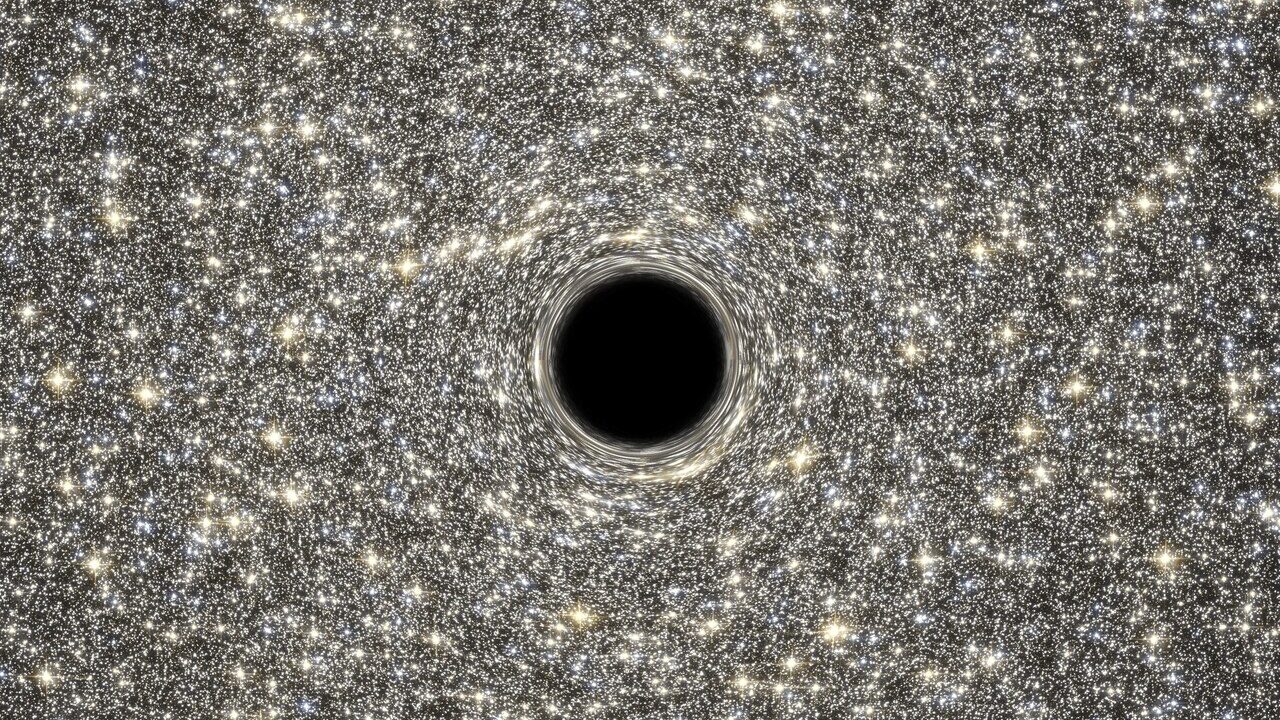
Astronomers have identified the first candidate “microblazar” — a miniature version of a quasar whose black hole fires a jet directly toward Earth — according to coverage of the detection across astronomy outlets this week. The object was located through a strange flash in deep space, and researchers describe it, carefully, as a candidate: the classification is proposed, not yet confirmed.
The name explains the concept. Blazars are among the most extreme objects known: supermassive black holes in distant galaxies whose jets happen to point almost exactly at us, making them appear ferociously bright and variable. A microblazar scales that geometry down to a stellar-mass black hole within a galaxy — the same trick of alignment at a fraction of the size. Finding one means finding a needle aligned with the haystack’s eye: jets point every which way, and only the rare one aimed at Earth announces itself this loudly.
If confirmed, the object would matter for two reasons. First, a nearby, scaled-down blazar would let astronomers study jet physics — how black holes launch particles to near light-speed — in a laboratory far closer and faster-evolving than any quasar. Second, the reporting around the candidate raises the stakes provocatively: such a jet, pointed our way, could produce some of the fastest particles in the Milky Way, feeding the long-running question of where the most energetic cosmic rays hitting Earth are manufactured.
Candidate is the operative word, and the scientists involved are using it. Extraordinary classifications require the elimination of ordinary explanations — flares, unusual variable stars, other classes of transient — and that work takes observing seasons, not news cycles.
For now, the object sits in the most productive category in astronomy: detected, unexplained, and pointed, apparently, at us. Confirmation would make it the first of a class. Refutation would teach almost as much.
Scepticism is built into the announcement’s wording, and properly so. Astronomy’s recent history includes aligned-jet claims that dissolved under follow-up observation into more mundane variability, and the burden on a “first of its kind” is correspondingly heavy: multi-wavelength monitoring, polarization measurements, and the slow exclusion of every ordinary suspect. If the candidate survives that gauntlet, textbooks gain a category — and observers gain a nearby laboratory for the physics that, at quasar distances, can only be watched in slow motion across cosmic time. The coming observing seasons will decide. Either the sky has given us a miniature blazar, or it has given us a first-rate mystery wearing one’s clothes; both are worth the telescope time.