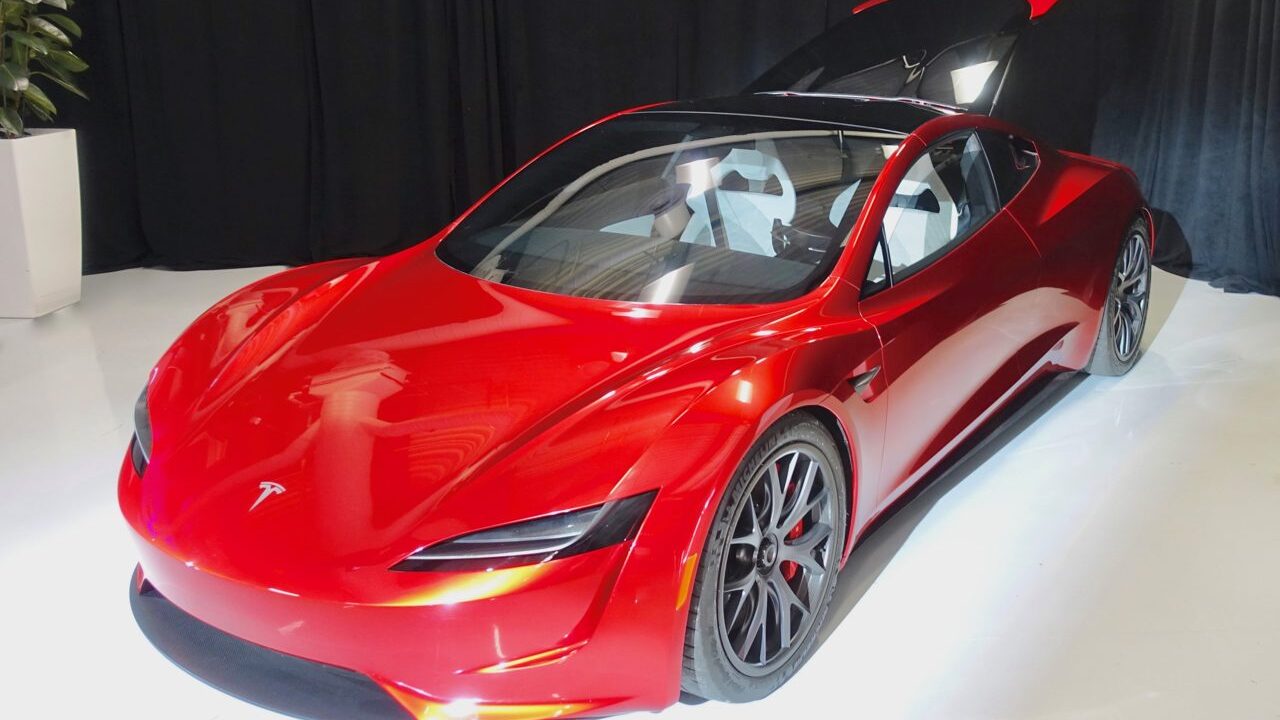
Tesla turned Thursday night’s Roadster reveal into a SpaceX engineering showcase, sending a white prototype up a curved ramp while upside down, through an aerial flip, and over a lineup of its own vehicles — powered not by rocket fuel but by cold-gas thrusters developed with its rocket-company sibling. The demonstration, streamed from SpaceX’s McGregor, Texas test site, ran without a driver at the wheel.
Compressed air, not rocket fuel
The heart of the stunt is an array of 10 cold-gas thrusters drawing down roughly 600 litres of compressed air, reported to generate more than 80 kilonewtons of thrust — enough to briefly lift and control a multi-thousand-pound sports car. Cold-gas thrusters are normally sized for small, precise adjustments in orbit, not for launching vehicles off the ground, so scaling the hardware from spacecraft duty to automotive duty is the real engineering story here.
The car also used an underbody suction-fan system, supplied by SpaceX, that let it cling to the ramp while inverted. The concept will be familiar to motorsport historians: fan-generated downforce was effectively banned from Formula 1 in the late 1970s after cars like the Brabham BT46B showed what active suction could do — one reason Tesla’s version will face its own regulatory questions if it ever reaches customers.
What is actually for sale — and what is not
Tesla lists three trims: Performance (claimed 0-60 mph under 1.6 seconds), Thrust (under 0.9 seconds with rear-mounted thrusters), and Rocket (under 0.59 seconds, single seat, invite-only, and “not approved for public road use”). Reservation payments run to $250,000 for the Thrust version — deposits, not final prices. Tesla announced no final purchase price for any trim, though it once quoted a $200,000 base price back in 2017.
Context matters: Musk set production for 2028, nine years after he first promised the car, and Tesla’s programme has a long history of missed dates — analysts are likely to treat the new target as aspirational until a production-representative car appears. Aviation rules also treat sustained airborne vehicles as aircraft, a regulatory wall the invite-only Rocket trim may never have to climb. And the 0.81-second figure on the stage timer, impressive as theatre, remains a company claim rather than an independent test — a reminder that the consolidation wave sweeping Big Tech, with giants buying their way into new markets, is no substitute for shipped product. The same regulators already wrestling with unmanned aircraft over American skies will have the final word on anything that truly flies. A detailed breakdown of the evening’s claims puts the confirmed facts and the open questions side by side.